
Advancing Sustainable Leadership in Travel & Hospitality
The Sustainable Sanctuary Awards (SSA) serves to recognize, celebrate, and amplify the achievements of extraordinary destinations, retreats, and industry leaders setting new standards in environmental stewardship and eco-centric hospitality. There are no entry fees to participate in the Awards and Category Winners are presented with Award Certificate and Trophy. There are however on-site auditor requirements that are to be provisioned by the Applicant.
Register your nomination here.
The SSA2026 is region based and the winners are unique to every region. Here are the regions currently supported:
South Asia | Central Asia | East Asia | South East Asia | Middle East
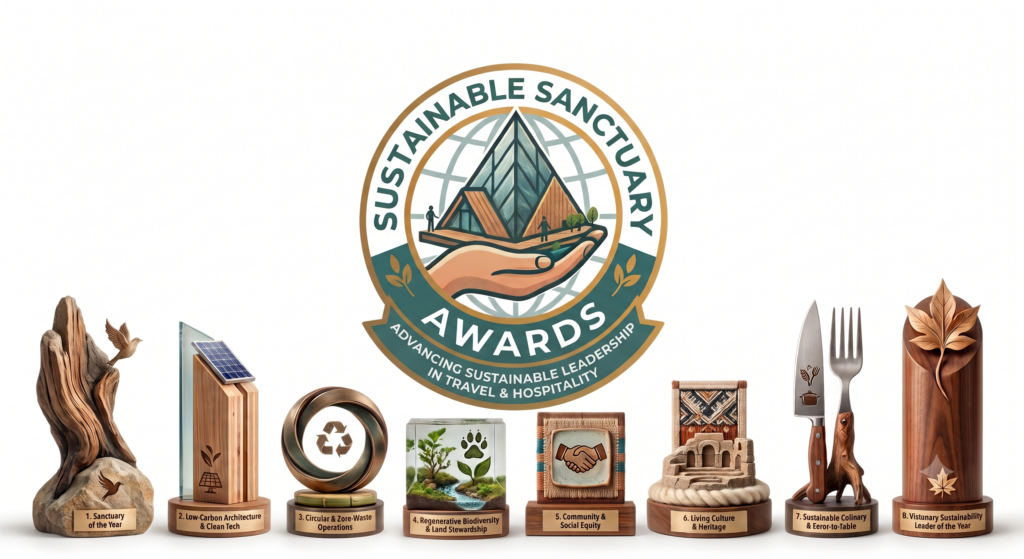
Award Categories
1. Sanctuary of the Year (Flagship Award)
- Pillars Covered: All 4 Pillars
- Focus: The highest honor awarded to a sanctuary or property demonstrating overall excellence across governance, community integration, cultural protection, and environmental performance.
2. Pioneer in Low-Carbon Architecture & Clean Tech
- Pillars Covered: Environmental Stewardship, Sustainability Management
- Focus: Exceptional integration of climate-resilient design, passive cooling/heating, renewable energy systems, and high-efficiency operations that drastically reduce Scope 1 and 2 emissions.
3. Excellence in Circular & Zero-Waste Operations
- Pillars Covered: Environmental Stewardship
- Focus: Outstanding performance in resource management—including single-use plastic elimination, organic waste composting, greywater/blackwater recycling, and closed-loop supply chains.
4. Regenerative Biodiversity & Land Stewardship
- Pillars Covered: Environmental Stewardship
- Focus: Projects and properties actively restoring degraded ecosystems, funding local rewilding initiatives, preserving native species, and protecting local natural habitats.
5. Champion of Local Community & Social Equity
- Pillars Covered: Local Community
- Focus: Leaders in fair-share economic development, inclusive local hiring practices, community-led infrastructure projects, and uplifting micro-enterprises within the host destination.
6. Guardian of Living Culture & Heritage
- Pillars Covered: Cultural Heritage, Local Community
- Focus: Recognizing properties that protect local historical sites, support indigenous craftsmanship, and offer authentic, non-commodified cultural experiences curated in partnership with local custodians.
7. Sustainable Culinary & Farm-to-Table Leader
- Pillars Covered: Environmental Stewardship, Local Community, Cultural Heritage
- Focus: Excellence in sustainable gastronomy—focusing on hyper-local sourcing, heritage crop preservation, minimal food miles, and zero-food-waste kitchen operations.
8. Visionary Sustainability Leader of the Year (Individual Human Award)
- Pillars Covered: Sustainability Management
- Focus: Honors an extraordinary individual (founder, sustainability director, or general manager) whose vision, advocacy, and leadership have accelerated sustainable change within their organization and the broader tourism sector.
Category Mapping Matrix
| Award Category | Target Applicant Type | Key Metric / Verification Focus |
| 1. Sanctuary of the Year | Full-scale resorts, boutique eco-lodges | Highest cumulative score on 100-point rubric |
| 2. Low-Carbon Architecture | Newly built or retrofitted green properties | kWh/m², passive design, renewable energy % |
| 3. Circular & Zero-Waste | Operations-heavy hospitality brands | % Landfill diversion rate, zero single-use plastics |
| 4. Regenerative Biodiversity | Nature reserves, eco-resorts, wilderness lodges | Hectares restored, native species count |
| 5. Community Champion | Community-focused tourism operations | Local hiring %, local vendor spend ratio |
| 6. Guardian of Culture | Heritage hotels, culturally integrated stays | Cultural custodian endorsements, local artisan spend |
| 7. Sustainable Culinary | Onsite dining, eco-restaurants | Food miles (km), % organic/local ingredients |
| 8. Visionary Leader | Individuals (CEOs, GMs, Sustainability Heads) | Personal impact, policy creation, industry advocacy |
On-Site Auditor Accommodation & Logistics Policy
Hospitality & On-Site Support Requirements
To facilitate a thorough and uninterrupted verification process, the applicant facility agrees to provide complimentary full board and lodging for the visiting Independent Technical Committee members during the official audit duration.
Specifically, the host property must provide:
- 3 Nights Accommodation: 2 high-tier accommodation units (such as a Suite, Premium/Executive Room, or top-category Villa) reflective of the property’s standard of hospitality, featuring private workspaces and quiet surroundings suitable for report drafting and documentation review.
- Meal & Dining: Full board provisions, including all daily meals (breakfast, lunch, and dinner) and non-alcoholic beverages, provided through the property’s primary dining venues or in-room dining services.
- Local Transfers: Direct ground transportation between the nearest major airport/transit hub and the property upon arrival and departure, where applicable.
Audit Assessment Framework
1. Sustainability Management
Evaluates the organizational strategy, governance, and operational policy to ensure long-term, verifiable commitment rather than superficial greenwashing.
- Policy & Governance: Long-term sustainability management system (SMS) in place, tailored to the property’s size and scope.
- Legal Compliance: Full adherence to local, national, and international environmental, labor, and safety regulations.
- Staff Engagement & Training: Regular employee training programs on sustainability protocols and operational best practices.
- Customer Communication: Transparent reporting on environmental goals and active encouragement of guest participation.
2. Local Community
Focuses on social equity, local economic empowerment, and human rights to ensure tourism directly benefits host communities.
- Inclusive Employment: Equal opportunity hiring prioritizing local residents across all employment tiers, including management.
- Local Purchasing & Supply Chain: Sourcing goods, services, and produce from local artisans, farmers, and micro-enterprises.
- Social & Economic Development: Active investment in community infrastructure, education, or public health programs.
- Exploitation & Rights: Strict policy against commercial, sexual, or labor exploitation, particularly involving vulnerable groups and children.
3. Cultural Heritage
Ensures the protection, respect, and celebration of tangible and intangible local heritage.
- Heritage Protection: Safeguard procedures for historical sites, artifacts, or culturally sensitive landscapes located on or near property.
- Authentic Interpretation: Accurate, respectful presentation of local tradition, indigenous customs, and historical narratives to guests.
- Local Enterprise Support: Incorporating local arts, crafts, and culinary traditions directly into guest experiences without commodification.
- Visitor Conduct: Informing guests on appropriate behavior and dress codes when visiting sacred or culturally sensitive sites.
4. Environmental Stewardship
Measures the physical operational impact on natural ecosystems, resource consumption, and biodiversity.
- Energy & Climate: Monitoring scope 1–3 emissions, maximizing energy efficiency (e.g., passive cooling, LED infrastructure), and integrating renewable energy sources.
- Water & Wastewater: Comprehensive water stewardship, rainwater harvesting, greywater recycling, and safe effluent treatment before discharge.
- Waste & Circularity: Zero-waste targets, complete elimination of single-use plastics, composting organic matter, and robust recycling streams.
- Biodiversity & Ecosystem Conservation: Active habitat regeneration, native landscaping, zero invasive species promotion, and non-intrusive wildlife interaction policies.
Audit Scoring Summary Matrix
| Assessment Area | Primary Verification Evidence | Key Compliance Goal |
| Sustainability Management | Written policies, monitoring logs, staff training records | Systematic operational control |
| Local Community | Local vendor invoices, HR demographic logs, community investment records | Equitable economic impact |
| Cultural Heritage | Cultural guidelines, local artisan partnerships, site protection logs | Respectful preservation |
| Environmental Stewardship | Utility metering data, waste audit logs, biodiversity impact assessments | Net-positive ecological balance |
Audit Checklist & 100-Point Scoring Rubric
Scoring Scale (Applied Per Criterion)
- Full Points (100%): Policy, execution, and verifiable tracking are fully documented and audited.
- Partial Points (50%): Initiative is active in practice, but lacks systematic documentation, tracking, or formal policy.
- Zero Points (0%): Non-compliant, unverified, or superficial execution (greenwashing).
Pillar 1: Sustainability Management (25 Points)
Evaluates organizational strategy, operational governance, and continuous improvement mechanisms.
| Ref | Assessment Criterion | Max Points | Audit Verification & Evidence Required | Score |
|---|---|---|---|---|
| 1.1 | Formal Sustainability Policy & SMS | 6 | Documented Sustainability Management System (SMS) updated within 12 months; clear leadership oversight. | /6 |
| 1.2 | Legal Compliance & Environmental Standards | 5 | Valid environmental permits, health & safety certifications, and labor law compliance records. | /5 |
| 1.3 | Staff Training & Capacity Building | 5 | Training logs showing 80%+ staff trained annually on sustainability SOPs and waste/energy management. | /5 |
| 1.4 | Data Tracking & Target Setting | 5 | Active monitoring dashboard for utilities, fuel, and waste with set multi-year reduction targets. | /5 |
| 1.5 | Guest Engagement & Transparency | 4 | Clear guest-facing sustainability communications and transparent public reporting of environmental impact. | /4 |
Pillar 2: Local Community (25 Points)
Measures social equity, local economic participation, and human rights standards.
| Ref | Assessment Criterion | Max Points | Audit Verification & Evidence Required | Score |
|---|---|---|---|---|
| 2.1 | Local & Inclusive Employment | 7 | HR records verifying ≥70% of total staff (and ≥40% of management) are hired from the local region. | /7 |
| 2.2 | Ethical Local Procurement | 6 | Vendor purchasing logs confirming priority sourcing from local farmers, artisans, and suppliers. | /6 |
| 2.3 | Community Infrastructure & Investment | 5 | Verifiable contributions (financial, material, or skill-based) to local public projects or schools. | /5 |
| 2.4 | Fair Trade & Exploitation Prevention | 4 | Documented code of conduct on fair wages, safe conditions, and strict anti-exploitation/child protection. | /4 |
| 2.5 | Community Consultation & Support | 3 | Record of regular dialogue or meetings with local community leaders and stakeholders. | /3 |
Pillar 3: Cultural Heritage (25 Points)
Ensures protection, authentic celebration, and respectful integration of tangible and intangible heritage.
| Ref | Assessment Criterion | Max Points | Audit Verification & Evidence Required | Score |
|---|---|---|---|---|
| 3.1 | Heritage & Sacred Site Protection | 7 | SOPs in place preventing physical damage to nearby historical sites, natural monuments, or sacred areas. | /7 |
| 3.2 | Authentic Cultural Representation | 6 | Guest programming and materials vetted by or created in partnership with local cultural experts. | /6 |
| 3.3 | Local Arts & Culinary Integration | 5 | Direct integration of traditional local cuisine, crafts, or performances into guest experiences with fair pay. | /5 |
| 3.4 | Guest Behavior Guidelines | 4 | Pre-arrival or in-room orientation guiding guests on respectful attire, photography, and cultural etiquette. | /4 |
| 3.5 | Intellectual & Cultural Property Rights | 3 | Policies ensuring indigenous or traditional knowledge is utilized ethically and with permission. | /3 |
Pillar 4: Environmental Stewardship (25 Points)
Direct operational measurement of carbon, resource efficiency, waste management, and biodiversity protection.
| Ref | Assessment Criterion | Max Points | Audit Verification & Evidence Required | Score |
|---|---|---|---|---|
| 4.1 | Energy Efficiency & Renewable Integration | 7 | Metering logs showing active usage reduction, passive design features, or onsite renewable energy generation. | /7 |
| 4.2 | Water Conservation & Circularity | 6 | Rainwater harvesting, greywater reuse systems, water-efficient fixtures, and safe wastewater treatment logs. | /6 |
| 4.3 | Waste Diversion & Zero Single-Use Plastics | 5 | Complete elimination of single-use plastic bottles/amenities; documented composting and recycling streams. | /5 |
| 4.4 | Biodiversity & Ecosystem Conservation | 4 | Native plant landscaping, active habitat regeneration/rewilding projects, and no invasive species promotion. | /4 |
| 4.5 | Low-Impact Design & Infrastructure | 3 | Low-embodied-carbon construction choices, non-toxic materials, and minimal land-disturbance footprint. | /3 |
Total Audit Rating System
| Total Score | Recognition Level | Audit Verdict |
|---|---|---|
| 90 – 100 Points | Platinum Sanctuary | Outstanding global benchmark; qualified for top category honors. |
| 75 – 89 Points | Gold Sanctuary | Strong compliance across all areas with minor operational gaps. |
| 60 – 74 Points | Silver Sanctuary | Meets baseline requirements; requires targeted improvements in low-scoring areas. |
| Below 60 Points | Unaccredited | Does not meet the minimum threshold for award certification. |
Applicant Handbook & Evidence Guide
Comprehensive Guidance for Award Nominees and Applicants
Welcome Applicants
This handbook outlines the mandatory documents, data logs, and visual evidence required when submitting an application for the Sustainable Sanctuary Awards.
Our evaluation process relies on objective, verifiable evidence across four core pillars. Submissions are judged on operational reality, not intent. Use this guide to assemble your submission dossier effectively.
Phase 1: Dossier Submission & Review
- Applicants complete the nomination form and submit supporting evidence across the 4 core pillars (management, community, culture, stewardship).
Phase 2: Independent On-Site Verification
- The independent technical committee schedules an on-site visit to inspect facility operations, interview key staff/community liaisons, and verify logs/permits.
Phase 3: Scoring & Certification
- Final scores out of 100 are compiled based on combined dossier evidence and on-site audit findings.
General Submission Guidelines
- Document Formats: PDF for written policies and logs; CSV/Excel for utility and financial data; high-resolution JPG/PNG for photographic evidence.
- Recency: Unless specified otherwise, data and log extracts must cover the most recent 12-month operational period.
- Language: All official policies and summaries must be provided in English (or submitted with an official translation alongside original local-language documents).
Optional Evidence Dossier by Assessment Area – Not Mandatory as Onsite Audit is Performed
Pillar 1: Sustainability Management
Weighting: 25% of Total Score
Goal: Prove that sustainability is embedded into corporate governance, day-to-day operations, and staff culture.
📁 Section_1_Sustainability_Management/
├── 1.1_Sustainability_Management_Plan.pdf
├── 1.2_Licenses_Permits_Compliance.pdf
├── 1.3_Staff_Training_Logs_and_Curriculum.pdf
├── 1.4_Utility_Monitoring_Dashboard.xlsx
└── 1.5_Guest_Communication_Collateral.pdf
| Criterion | Required Documents & Evidence | Accepted File Types |
| 1.1 Management System | Signed Sustainability Policy Statement; copy of the property’s active Sustainability Management System (SMS) or master plan; organization chart showing sustainability oversight roles. | .pdf |
| 1.2 Compliance & Standards | Valid operating licenses, environmental permits, discharge permits, health & safety audit certificates, and labor law compliance declarations. | .pdf |
| 1.3 Staff Capacity | Annual staff training schedule; attendance logs showing percentage of staff trained on eco-SOPs; sample training presentation/module. | .pdf, .xlsx |
| 1.4 Performance Tracking | Monthly consumption tracking logs (electricity, diesel/gas, water, waste) covering the last 12 to 24 months; copy of multi-year reduction targets. | .xlsx, .csv |
| 1.5 Guest Transparency | Digital links or PDFs of guest-facing sustainability collateral (in-room guides, website disclosures, annual impact summaries). | .pdf, URLs |
Pillar 2: Local Community
Weighting: 25% of Total Score
Goal: Demonstrate fair labor practices, local economic inclusion, and positive social contribution.
📁 Section_2_Local_Community/
├── 2.1_HR_Demographic_Report.pdf
├── 2.2_Local_Vendor_Purchasing_Ledger.xlsx
├── 2.3_Community_Investment_Receipts.pdf
├── 2.4_Fair_Labor_Anti_Exploitation_Code.pdf
└── 2.5_Stakeholder_Meeting_Minutes.pdf
| Criterion | Required Documents & Evidence | Accepted File Types |
| 2.1 Inclusive Hiring | Anonymized HR roster indicating employee home region/residency status to verify local employment percentages (overall and management level). | .pdf, .xlsx |
| 2.2 Local Procurement | Accounts payable summary or vendor ledger highlighting total spend allocated to local farmers, suppliers, and micro-enterprises within a 100 km radius. | .xlsx, .pdf |
| 2.3 Social Investment | Receipts, formal partnership agreements, or financial statements verifying donations, infrastructure funding, or education sponsorships for host communities. | .pdf |
| 2.4 Human Rights & Labor | Employee handbook detailing fair living wages, staff benefits, anti-harassment policies, and a signed statement prohibiting child or forced labor. | .pdf |
| 2.5 Community Dialogue | Minutes, attendance sheets, or summary reports from regular town halls or feedback sessions with local community leaders. | .pdf |
Pillar 3: Cultural Heritage
Weighting: 25% of Total Score
Goal: Show respectful integration, preservation, and promotion of local cultural assets and traditions.
📁 Section_3_Cultural_Heritage/
├── 3.1_Heritage_Protection_SOP.pdf
├── 3.2_Cultural_Expert_Endorsement.pdf
├── 3.3_Artisan_and_Culinary_Contracts.pdf
├── 3.4_Guest_Etiquette_Guidebook.pdf
└── 3.5_Photo_Dossier_Cultural_Integration.zip
| Criterion | Required Documents & Evidence | Accepted File Types |
| 3.1 Heritage Protection | Written SOPs detailing rules for property interactions with nearby historical sites, natural monuments, or sacred grounds; physical boundary protection plans. | .pdf |
| 3.2 Authentic Representation | Letters of endorsement or advisory contracts with local cultural custodians, historians, or indigenous representatives who review guest programming. | .pdf |
| 3.3 Local Arts & Gastronomy | Supplier contracts with local artisans, performers, or chefs; menus highlighting traditional local dishes and locally sourced heritage ingredients. | .pdf |
| 3.4 Guest Code of Conduct | Copy of guest orientation briefings, pre-arrival welcome letters, or signage outlining culturally respectful behavior, dress codes, and photography rules. | .pdf, .jpg |
| 3.5 Visual Proof | Dated photo/video dossier showing physical heritage conservation efforts, local architectural elements, and cultural programming in practice. | .zip (.jpg/.png) |
Pillar 4: Environmental Stewardship
Weighting: 25% of Total Score
Goal: Provide hard metrics and visual proof of resource efficiency, waste diversion, and ecosystem conservation.
📁 Section_4_Environmental_Stewardship/
├── 4.1_Energy_Bills_and_Renewable_Specs.pdf
├── 4.2_Water_Management_Flowchart.pdf
├── 4.3_Waste_Audit_and_Disposal_Logs.xlsx
├── 4.4_Biodiversity_and_Rewilding_Report.pdf
└── 4.5_Photo_Dossier_Clean_Tech_Eco_Systems.zip
| Criterion | Required Documents & Evidence | Accepted File Types |
| 4.1 Energy & Decarbonization | 12 months of utility/fuel bills; technical specs of solar/renewable installations; energy audit report or proof of passive design/HVAC efficiency systems. | .pdf, .xlsx |
| 4.2 Water Stewardship | Water consumption meter logs; schematic diagrams of rainwater harvesting or greywater/blackwater treatment systems; water quality test results. | .pdf, .jpg |
| 4.3 Waste & Circularity | Waste audit manifests showing monthly volume diverted (composted/recycled vs. landfill); single-use plastic elimination policy and procurement audit. | .xlsx, .pdf |
| 4.4 Biodiversity Protection | Native plant species inventory; land management or rewilding progress report; wildlife interaction rules; proof of zero chemical pesticide/herbicide policy. | .pdf |
| 4.5 Visual Proof | Comprehensive photo dossier of clean technology in action (solar arrays, composting bays, treatment plants, native gardens, energy metering displays). | .zip (.jpg/.png) |
Submission Checklist & Verification
Verification Notice: All submissions are subjected to a onsite audit. All applicants will be subject to a scheduled on-site verification audit by our independent technical committee.
Before submitting your final zip file or uploading to the portal, ensure:
- Every folder contains its designated documents named according to the naming convention (
[Ref_No]_[Document_Title].[ext]). - Data spreadsheets include clear units of measurement (e.g., kWh, Liters, Metric Tons, Local Currency).
- Contact details for two verifiable professional references (e.g., local community leader, environmental officer) are included in the master cover sheet.